Voice Recognition
X
Welcome to the Cuyahoga Falls City School District.

Cuyahoga Falls City School District

The hub of our community, committed to a culture of caring! We innovate. We create. We personalize education for all!

Finance Fridays

Finance Friday Topics

Why does the district lease space for the Board of Education offices?

Why does the district lease space for the Board of Education offices?

Here’s some helpful background:

The previous Board Office was located in a wing of the former Cuyahoga Falls High School, which was built in 1960. With the opening of the new 6–12 campus in January 2026 and the impending sale of the building, the district needed to identify a new location.

Why weren’t offices included in the new campus?
The Ohio Facilities Construction Commission (OFCC) provides state funding for classroom and educational spaces. Administrative offices are not eligible for that funding, which means taxpayers would have to cover 100% of the cost of constructing office space on the new campus.

How much space is needed?
A facilities study determined the Board of Education offices require approximately 11,000–13,000 square feet.

Could an existing school building be used?
Several buildings were reviewed, including Roberts Middle School and multiple elementary schools. For example, Roberts Middle School is 75,000 square feet—about 62,000 square feet larger than needed—and costs approximately $120,000 per year in utilities alone, not including custodial staff, maintenance, or long-term repairs. According to a facilities study, retrofitting Roberts into an office space would have cost more than the entire 7 year lease. 

The current solution:
A commercial space at 405 Tallmadge Road met the district’s needs.

Key details of the lease:
• Approximately 13,000 square feet (aligned with the space study)
• $12 per square foot, with a 2% annual increase over 7 years
• The district leases only the second floor of the building
• The landlord provided a move-in ready facility at no additional cost to the district.

Looking ahead, revenue from the future sale of Roberts Middle School can be used to support district financial needs.


Property Taxes and HB 920

 How Your Property Tax is Calculated

  • Your home's market value is multiplied by 35% to get your assessed (taxable) value

  • That assessed value is then multiplied by the millage rate to determine your tax bill

  • 1 mill = $1.00 per $1,000 of assessed value per year

  • Example: A $100,000 home ? taxed on $35,000 assessed value

An infographic that describes how your property tax is calculated.


What is HB 920? (House Bill 920)

  • Passed in 1976, HB 920 is an Ohio law that limits how much tax revenue schools can collect

  • If property values go up, the auditor cuts the school tax rate — so schools don't collect more

  • If property values go down, the tax rate increases — so schools still collect the same amount

  • HB 920 essentially freezes school levy revenue at the amount voters originally approved

  • Inflation may raise your home's value — but it doesn't mean more money for schools


The $100 Table — A Simple Analogy

  • Imagine 4 neighbors vote to fund their school with $100 total ? each pays $25

  • A 5th neighbor moves in? The $100 is split 5 ways, each now pays $20

  • The school still collects exactly $100 — no more, no less

  • When the community shrinks, each person pays more (e.g., 3 people ? each pays $33)

  • The voted dollar amount stays the same — the rate adjusts to match

An infographic that shows what each contribution is based on the number of taxpayers in each scenario.


Property Revaluations & What They Mean for Schools

  • Ohio law requires property to be revalued every 3 years, with a full reappraisal every 6 years

  • In 2023, Summit County saw a 26.48% increase in property valuations

  • The next full reappraisal is set for tax year 2026

  • Despite rising property values, school revenue doesn't increase — due of HB 920

  • Rising valuations may affect your tax bill, but schools are not collecting more


Finance Friday: The "Inside Knowledge" on Inside Millage

Finance Friday: The "Inside Knowledge" on Inside Millage
When you look at your property tax bill, you are seeing a combination of different "mills." Most of these were voted on by the community (Outside Millage), but there is a small, specific portion that exists by law. This is called Inside Millage.

What is Inside Millage?
Inside millage, also known as "unvoted millage," is a portion of property taxes authorized by the Ohio Constitution. Unlike the levies you see on a ballot, local governments are permitted to levy this without a direct vote, up to a strict combined limit of 10 mills (or 1%) per taxing district.

How is the "Pie" Sliced?
That 10-mill limit isn't just for schools; it is shared among all the local branches of government that serve you. This typically includes:

Public Schools
The County
Municipalities (City/Village)
Townships
Special Districts

In our community, CFCSD receives 4.90 mills of that total. This allocation is set by the county budget commission or the courts.

Why It’s Different: The Growth Factor
This is the most important part to understand: Inside millage is not subject to House Bill 920 reduction factors.

As we’ve discussed in previous weeks, HB 920 usually "levels out" your taxes so the school district doesn't get a windfall when home values rise. However, the Ohio Constitution treats inside millage differently.

Proportional Growth: Revenue from inside millage rises and falls at the exact same rate as property values.

The Reality: When property values in Cuyahoga Falls increase, the revenue from these 4.90 mills increases proportionally.

Why Does Inside Millage Exist?
Because almost all other school funding is "frozen" at the dollar amount originally voted on, inside millage is one of the very few tools schools have to help offset the rising costs of inflation. It allows the district to capture a small amount of growth to help cover the increasing costs of running a modern school district—from heating buildings to fueling buses.

The Big Picture
While inside millage does increase when your property value goes up, remember that it only represents a small fraction of your total tax bill. The vast majority of your school taxes (the "Outside Millage") remain protected and leveled out by HB 920.

Understanding the "20 Mill Floor"

Finance Friday: Understanding the "20 Mill Floor"

Summary: Cuyahoga Falls is currently above the 20-mill floor. This means HB 920 is still protecting you from seeing your taxes rise as fast as your property value.

If you’ve been following the news about Ohio property taxes, you’ve likely heard the term "20-Mill Floor." While it sounds like a construction term, it is actually one of the most important parts of how schools are funded.

What is the 20 Mill Floor?

Think of the 20-mill floor as a legal safety net—but it’s a net designed for the school district, not necessarily the taxpayer.

In 1976, Ohio passed House Bill 920. This law protects you by lowering tax rates as property values rise so that school districts don't get a "windfall" of cash just because your home is worth more. However, the state also realized that if those rates kept dropping forever, schools eventually wouldn't have enough money to stay open.

To prevent this, the law created a "Floor." It states that a community’s tax rate for school operations cannot fall below 20 mills (or $20 for every $1,000 of assessed value).

Why "The Floor" Changes the Rules

Usually, HB 920 protects you from tax spikes. But once a district hits that 20-mill floor, that protection turns off.

  • In districts AT the floor: When property values go up, taxes go up at the exact same rate because the law won't let the millage drop any lower.

  • In districts ABOVE the floor (Like Cuyahoga Falls): HB 920 is still active. As your property value increases, your tax rate is adjusted downward to keep the revenue stable.

Does everything count toward the "Floor"?

Not quite. Only "Operating Levies"—the money used for the day-to-day costs of teaching students—count toward this 20-mill minimum.

  • What doesn't count: Money for new buildings (Bond issues) or Permanent Improvements (PI levies) are kept separate.

  • Recent Changes: Historically, "Emergency Levies" didn't count toward the floor either, though new legislation is starting to change that math (which we will cover in a future Finance Friday!).

The Bottom Line for Cuyahoga Falls

We know there is a lot of debate across Ohio regarding rising tax bills. However, because Cuyahoga Falls remains above the 20-mill floor, our taxpayers continue to be shielded by HB 920.

The most important takeaway: A 26% increase in your property value in Cuyahoga Falls is not a 26% increase in your property taxes.

While you may see small increases in "inside millage" (unvoted taxes), the majority of your school tax remains leveled out. We remain committed to balanced property tax reform that protects both our homeowners and the high-quality education our students deserve.

Understanding the New Inflation Caps (HB 186 & HB 335)

Finance Friday: Understanding the New Inflation Caps (HB 186 & HB 335)

Summary: New laws cap our revenue at inflation, even when our actual costs for running schools rise faster. This results in a projected $952,000 loss for CFCSD.

Two pieces of legislation—House Bill 186 and House Bill 335—have added new layers of complexity to how your schools are funded.

While these bills are often discussed as tax relief, they create a significant "Revenue Gap" that school districts must navigate.

The "Inflation Cap": A New Speed Limit on Funding

Traditionally, some parts of school funding could grow naturally as property values increased. This helped schools keep up with the rising costs of doing business.

HB 186 and HB 335 have changed the rules. They place a "cap" or a speed limit on how much revenue a school district can receive from property reappraisals. Now, even if property values spike, the district’s revenue growth is limited to a three-year average of inflation (technically called the GDP Deflator).

Why this creates a $952,000 challenge for Cuyahoga Falls

You might ask: "If the district gets an increase tied to inflation, isn't that enough?" Unfortunately, school costs don’t always follow standard inflation. The cost of bus fuel, specialized classroom equipment, and the state-mandated services we provide can rise much faster than the "average" inflation rate.

  • The Result: Under HB 335, our district is restricted from receiving the full benefit of property value updates.

  • The Impact: We estimate a $952,000 reduction in revenue for our district compared with our previous projection. That is nearly $1 million that will not be available for our classrooms and programs.

The Problem of "Phantom Revenue" (HB 186)

HB 186 introduces another challenge: The Phase-out of Credits. By 2029, the state is phasing out the 10% non-business rollback credit. While they are increasing the owner-occupied credit to offset some of this for homeowners, the state has not adjusted the school funding formula to make up the difference for districts.

This creates what experts call "Phantom Revenue." On paper, the state’s math makes it look like the district has more local support than it actually does. In reality, the state is providing less, and the district is left with a funding hole that the local community is then forced to fill.

What this means for you

Because Cuyahoga Falls is currently above the 20-mill floor, some parts of these bills (like the Inflation Cap Credit clawback) don't apply to us yet. However, the overall restriction on our revenue remains a hurdle.

We believe in a transparent funding system where "inflation caps" don't become "funding cuts." As your property values grow, these laws ensure the district's budget remains restricted, requiring us to be more efficient than ever with the resources we have.


Technical Shifts and New Oversight: Understanding HB 129 and HB 309

Technical Shifts and New Oversight: Understanding HB 129 and HB 309

As we move further into our Finance Friday series, it’s important to look at how the State of Ohio is changing the administrative rules for the levies our community supports.

HB 129: Redefining the "20-Mill Floor"

We previously discussed the "20-Mill Floor"—the minimum funding level for schools. House Bill 129 changes the math behind that floor.

  • What’s changing: Starting in Tax Year 2026 (CY2027) for Summit County, "Fixed-Sum" or Emergency Levies will now be included in the floor calculation.

  • The Impact: For Cuyahoga Falls City School District, this is primarily an accounting change. While it alters how the state views our funding "floor," it is not expected to change the actual revenue we collect from our residents.

HB 309: A New Level of Local Oversight

House Bill 309 introduces a significant change in how voter-approved levies are managed. It grants County Budget Commissions the authority to reduce levies (excluding debt) if they are deemed "excessive" based on new state definitions.

  • The Protection: New levies have a one-year "protection period" where they cannot be reduced.

  • The Uncertainty: This law requires school districts to declare annually whether they will collect or forgo additional revenue from inside millage. Because this power sits at the county level, it introduces a level of unpredictability into our long-term financial planning.

Why does this matter to you?


At Cuyahoga Falls City School District, we value the trust you place in us when you vote for a levy. These laws add new layers of state and county oversight that can change the "fixed" nature of that funding. We will continue to advocate for local control and the stability of the resources our voters have approved for our schools.

The Vanishing State Reimbursement (HB 59 & HB 96)

One of the biggest misconceptions in school finance is that the state "makes up the difference" when tax rules change. In reality, over the last decade, several legislative moves have shifted the financial responsibility for schools away from Columbus and onto local communities.

HB 59: The End of the "Rollback"

For decades, Ohio homeowners enjoyed a "10% and 2.5% rollback" on their property taxes. The homeowner paid the majority, and the State of Ohio paid the remaining 12.5% directly to the school district. It was a partnership that kept local taxes lower.

In 2013, House Bill 59 ended that partnership for all new levies.

  • Pre-2013 Levies: These are "grandfathered" in. The state still pays the 12.5% reimbursement as long as the levy remains in place.

  • Post-2013 Levies: The state provides $0 in reimbursement. The full cost of these levies is paid by local property owners.

  • The Risk: If a pre-2013 levy expires or is replaced, that state "discount" vanishes forever, increasing the local tax burden.

HB 96: Unfunded County Exemptions

House Bill 96 introduced a new layer of uncertainty. It gives counties the authority to adopt their own property tax exemptions (expanding the Homestead Exemption for seniors or disabled residents) or increase owner-occupied credits.

Unlike the traditional Homestead Exemption—where the state pays the district back for the taxes the senior doesn't have to pay—HB 96 allows these "piggyback" exemptions to be unreimbursed.

  • The Result: If a county chooses to grant these exemptions, the school district simply loses that revenue.

  • Our Status: Summit County did not adopt these for the 2025 tax year, but they remain an option for 2026 and beyond. This makes long-term financial forecasting difficult for the district.

What This Means for Cuyahoga Falls City School District

These bills represent a trend of "unfunded mandates" and shifting costs. When the state reduces its reimbursements or allows for new exemptions without replacing the funds, the district is forced to do more with less.

We support tax relief for our residents, but we also advocate for a funding system where the state remains a reliable partner in supporting public education.

Lottery Funding: Myth vs. Reality

A graphic with a table that shows the difference between the cost to educate a student, which is $12,000, and the amount of lottery revenue we receive, which is $900.Since 1987, the Ohio Constitution has required that lottery profits support K-12 education. Ohio's lottery generates about $1.4 billion annually for education. While this sounds like a significant windfall, it is important to understand that lottery funds are supplemental, not a replacement for local taxes.

A "Replacement" System: The biggest misconception is that districts like Cuyahoga Falls see an increase in funding when lottery sales rise. In reality, lawmakers set total school funding through the state budget. If the lottery generates more revenue, the state often uses those funds to cover its existing share, effectively replacing general tax dollars rather than adding extra money to schools.

By the Numbers:

  • 25 Cents: Only about $0.25 of every $1 spent on a ticket becomes profit for schools.

  • The Per-Student Reality: If distributed evenly, lottery revenue amounts to about $900 per student.

  • The Actual Cost: It costs over $12,000 to provide a year of education, including salaries, technology, purchased services, and utilities.

Local Support is the Foundation: The lottery has supported education for decades, but it does not increase overall school funding. Local support remains the most vital and reliable piece of the financial puzzle for the Cuyahoga Falls City School District.

DeRolph and the 30-Year Battle for Fair Funding

An infographic that shows a timeline of Ohio's school funding from the DeRolph ruling in 1997, and shows that the funding from this court case is still unresolved.

On March 24, 1997, the initial DeRolph v. State of Ohio school funding ruling by the Ohio Supreme Court was handed down. Now, almost 30 years later, the constitutional violation cited in that case remains a central part of the conversation regarding Ohio school funding.

What was DeRolph?

Nathan DeRolph was a student in the Northern Local School District in Perry County, one of five school districts to sue the state in 1991. The lawsuit contended that Ohio’s school funding system, based on local property taxes and augmented by state aid, was unconstitutional, violating the "Thorough and Efficient" clause of the Ohio Constitution.

The Two Core Principles:

  1. Adequacy: The court ruled the state must use objective, cost-based methods to determine the “base cost” of educating a typical student, including additional funding for students with greater needs (disabilities, English learners, and economically disadvantaged students).

  2. Equity: The court ruled that the system must not rely too heavily on local property taxes, as this creates disparities in educational opportunities between students in wealthier and poorer districts.


A Practical Win: New Facilities
Beyond the classroom budget, the DeRolph ruling established that the state must help fund the construction and repair of school buildings. This led to the creation of the Ohio Facilities Construction Commission, which has disbursed over $11 billion statewide. Locally, this provided $39 million toward the construction of our new 6-12 campus, a direct result of this historic legal battle.

Is the Battle Over?

The court withdrew from enforcement in 2002 not because the problem was solved, but because it had exhausted its ability to force compliance. The ruling was never reversed.

The issue returned to the forefront in June 2025, when Judge Jaiza Page found Ohio’s EdChoice voucher program unconstitutional under the same constitutional article cited in DeRolph. Two courts, decades apart, have reached the same conclusion: Ohio’s school funding system continues to struggle with constitutional mandates, leaving local residents to bridge the funding gap.

The Funding Rollercoaster

The Lost Decade: Riding the Ohio School Funding Rollercoaster (2012–2021)

To understand the current state of public school finance in Ohio, one must look at the highly volatile decade spanning 2012 through 2021. During these years, legislative changes created an unstable fiscal landscape for public school districts across the state.

1. Funding Without a Formula (2012–2013)

Following the 2008 recession and successive state budget re-evaluations, Ohio temporarily abandoned a structured funding formula. School districts were funded based on historical allocations from prior years. When federal stimulus resources expired, public schools faced immediate, severe revenue cliffs.

2. Unbacked Metrics and Workarounds (2014–2019)

When a formula was reintroduced, the per-pupil base amounts (starting at $5,745) were determined legislatively rather than through objective, cost-based research regarding what it actually takes to educate a child.

Because the state's formula proved highly unpredictable and widely criticized as inequitable, lawmakers routinely implemented caps and guarantees to prevent extreme budget swings. These workarounds became the norm: by 2019, only 1 in 5 Ohio school districts were actually being funded through the core formula as intended. The remaining 80% were caught in temporary funding provisions.

3. The Funding Freeze (2020–2021)

Unable to find an equitable consensus, the state completely froze education funding at 2019 levels for two consecutive fiscal years, ignoring shifting enrollment numbers, local wealth metrics, and inflationary realities.

The Direct Deduction System

Compounding these systemic weaknesses was Ohio's historical "direct deduction" policy. When a student living within our district boundaries utilized an EdChoice voucher or enrolled in a charter school, the funding was deducted directly out of Cuyahoga Falls’ state aid allotment rather than being funded independently by the state. This structurally penalized local districts, shifting the financial burden onto local property taxpayers.


Fair School Funding Plan: The Framework

The Mechanics of Ohio's Fair School Funding Plan: Theory vs. Framework

In 2021, the Ohio General Assembly enacted the Fair School Funding Plan (FSFP). Designed as a 6-year phased rollout culminating in full implementation by the 2026-27 school year, the framework was heralded as a historic correction to decades of unconstitutional public education funding models in Ohio.

To fully analyze how this legislation affects the Cuyahoga Falls City School District, it is essential to first understand the structural mechanics of how the formula is designed to operate on paper. 

Pillar 1: The Component-Based "Base Cost"

Historically, Ohio determined education funding via politically negotiated per-pupil figures. The FSFP fundamentally shifted this paradigm by replacing arbitrary targets with a researched "Base Cost" model. Under this approach, the cost of educating a student is dynamically calculated based on what it actually costs to staff and operate a high-quality school district.

The formula anchors its Base Cost calculation across four primary educational components:

  1. Classroom Instruction (60%): Direct instructional costs including teacher ratios, standard employee benefits, and academic materials.

  2. Building Operations (20%): Core logistical support including custodial staff, building maintenance, security, and utility expenses.

  3. Student Support Services (15%): Non-instructional student resources essential to modern educational environments, such as technology, guidance counselors, media specialists, and nursing staff.

  4. District Leadership (5%): Essential managerial oversight, superintendent and treasurer expenses, and compliance operations.

Pillar 2: Determining Local Capacity and State Share

Once the baseline operational cost of a district is established, the formula applies a local capacity matrix to determine the funding split between state allocations and local responsibility. Rather than relying solely on erratic property valuations, the FSFP uses a dual-indicator system to determine a community's realistic wealth index:

  • Local Property Values (Weighted at 60%): Assessed valuation of agricultural, residential, commercial, and industrial property within district boundaries.

  • Resident Income Levels (Weighted at 40%): Federal Adjusted Gross Income (AGI) and median income data for taxpayers residing within the community. 

By pairing these two metrics, the formula is intended to balance state aid distribution equitably: communities with constrained local tax bases and lower average incomes receive a significantly higher percentage of state assistance, while higher-wealth communities are required to generate more of their operational budgets via local tax levies.

Pillar 3: Categorical Aid Overlays

Recognizing that standard base costs do not cover the specialized funding required for diverse student bodies, the FSFP overlays targeted funding streams. These funding add-ons are distributed to districts based on precise enrollment numbers in specialized categories, including:

  • Special Education services

  • Economically Disadvantaged student support

  • English Language Learners (ELL)

  • Gifted and Talented education

  • Career-Technical Education (CTE) programs

The Imminent Disconnect

The structural mechanics of the Fair School Funding Plan represent a major step forward for Ohio in theory. However, a formula is only as effective as the integrity of its data inputs.

Fair School Funding Plan: The Shrinking State Share

The Frozen Formula: Tracking the Statewide Decline in Ohio School Funding

When the Fair School Funding Plan (FSFP) was enacted in 2021, its primary objective was to establish an annually updated, data-driven mechanism to fund public education equitably. However, an analysis of statewide funding data reveals a widening gap between legislative intent and fiscal reality.

Data presented by Dr. Howard Fleeter to the House Education Committee outlines a clear and systemic retreat in the state's investment in public education.

The Mechanics of the Cost Shift

The funding erosion is driven by a structural imbalance in how the state updates the formula's data inputs. The foundation formula operates on an equilibrium between two metrics:

  1. The Local Wealth Index: Measured via local property valuations and household income.

  2. The Base Cost Input: Measured via real-world operational costs, including teacher salaries, health benefits, technology, and building maintenance.

State budget implementations have updated local property valuation metrics regularly, capturing recent inflationary increases in real estate values. However, the state has concurrently frozen the Base Cost inputs at fiscal year 2022 levels.

Because the formula sees rising local property wealth but ignores the parallel rise in school operational costs caused by inflation, the mathematical output automatically reduces the state’s required share of funding.

Ohio’s National Standings

By utilizing frozen base cost data, the state has minimized its educational expenditures at the direct expense of local communities. This systemic underfunding has significantly impacted Ohio’s national standing in public education support:

  • Ohio currently ranks 41st in the nation regarding state funding per pupil.

  • The state's per-pupil funding contribution sits $2,672 below the national average.

  • While Ohio property taxes rank 8th highest nationally, those local revenues are increasingly utilized to backfill the deficit left by declining state percentages rather than enhancing classroom resources.

Conclusion

The Fair School Funding Plan framework was designed with the mandate that all data points must be updated in tandem to maintain equity. Freezing the operational cost side of the equation while allowing property values to rise functions as an artificial mechanism that reduces state accountability.

FSFP: The Crumbling Wall of State Support

The Local Reality of the State Funding Shift: Cuyahoga Falls Faces the 10% Minimum Floor

While the structural layout of the Fair School Funding Plan (FSFP) was built on the principle of equity, the operational reality for the Cuyahoga Falls City School District highlights a stark fiscal challenge. Due to the state's practice of freezing base cost inputs while regularly updating community property metrics, local school districts are experiencing an artificial deflation of state aid.

The Mathematical "Shell Game" Explained

The funding formula functions as a legal scale. On one side is local community wealth (calculated via property values and income indices); on the other side is the operational base cost of providing a baseline education.

When state budgets continually update local valuation data, the formula treats the local community as increasingly wealthy and self-funding. If the baseline operational costs remain anchored to the 2022 historical data, the formula indicates that the district requires fewer state resources. This systemic imbalance shifts the cost burden directly onto local residential property tax bases.

Five-Year Projections for Cuyahoga Falls CSD

The concrete impact of this data freeze is demonstrated in our district's financial projections, showing a rapid trajectory toward the state's absolute minimum funding floor:

Metric

FY 2026

FY 2027

FY 2028

FY 2029

FY 2030

Total Calculated Base Cost

$31,577,192

$30,661,457

$29,794,616

$29,313,762

$29,308,056

Current Enrollment

3,843

3,731

3,622

3,562

3,562

Per Pupil Base Cost

$8,216

$8,218

$8,225

$8,229

$8,229

Local Capacity Per Pupil

$6,418

$7,067

$7,403

$7,406

$7,406

State Share Per Pupil

$1,798

$1,151

$822

$823

$823

State Funding % of Base Cost

21.88%

14.01%

10.00%

10.00%

10.00%


Source: Cuyahoga Falls CSD Financial Records & Formula Local Capacity Matrix.

The 10% Floor and Local Implications

By Fiscal Year 2028, the state’s financial contribution to Cuyahoga Falls will drop to 10.00%—the absolute bare legal minimum funding level permitted by Ohio law. This leaves the state contributing just $822 per student.

This minimum funding floor is applied despite the demographic reality that 58% of Cuyahoga Falls students qualify as economically disadvantaged. Consequently, local tax revenues are increasingly required to bridge the expanding fiscal gap created by the state's frozen formula metrics. 

Civic Advocacy: Contacting State Leadership

These financial paths are shaped directly by state legislative decisions. To prevent the ongoing transfer of educational costs entirely to local voters, community members can engage in direct legislative advocacy.

Residents can contact their state officials to request that the Fair School Funding Plan's cost components be fully updated to reflect modern inflationary pressures.

Finance Friday: The Flipped Scales

Chronology of the State-to-Local Property Tax Shift

When local residents examine their property tax bills, the common assumption is that local entities are overspending. However, an analysis of Ohio's fiscal history reveals a highly structured, thirty-year legislative effort that has systematically reduced business tax contributions and transferred the core operational costs of public education directly to residential property owners.

A graphic featuring two bar graphs with the text, "The flipped scales." It demonstrates how the burden of school funding has shifted from businesses and utilities to homeowners and farmers since 1991.

The Architecture of a Policy Shift

In 1991, commercial enterprises and utility companies paid the majority of school property taxes across Ohio's 612 school districts. Today, that dynamic has completely inverted. Homeowners and agricultural property owners now cover 67.5% of all school property taxes.

This systemic cost-shift is the direct consequence of four key state-level legislative milestones:

1. 2005: Repeal of the Tangible Personal Property (TPP) Tax

Prior to 2005, commercial businesses paid a tangible personal property tax on manufacturing machinery, inventory, and operational equipment. The Ohio General Assembly voted to phase out this tax entirely. While temporary "state reimbursement payments" were initially given to school districts to cushion the blow, those funds were accelerated and completely phased out by 2012, resulting in a permanent loss of $1.6 billion in annual revenue to local public entities.

2. 2013: Elimination of the State 10% and 2.5% Tax Rollbacks

For decades, the State of Ohio provided direct property tax relief by paying 12.5% of local residential property tax bills directly to school districts on behalf of homeowners. In 2013, the state eliminated this funding mechanism for all new, additional, or replacement levies passed by local communities. This legislative rollback effectively increased the out-of-pocket cost of all subsequent local school levies by 12.5%, moving the cost straight onto the homeowner.

3. 2013–2025: Income Tax Base Reductions

Repealed state income brackets and continuous income tax rate cuts over the past decade have fundamentally shrank the State of Ohio's General Revenue Fund. With a smaller primary revenue pool, state allocations for public education have stagnated, forcing local operational dollars to act as the primary backstop for school operational survival.

4. 2024: Devaluation of Utility and Power Plant Taxes

Recent legislative adjustments targeting utility property tax assessments significantly lowered the taxable valuation of power generation facilities and utility infrastructure. This specialized corporate devaluation further shrank local commercial tax collections, forcing residential property bases to assume an even larger percentage of the local funding footprint.


Divergent National Standings

This ongoing policy timeline has placed Ohio in an anomalous national position where local tax rates are heavily disconnected from state education investments:

  • Local Property Taxes: Ohio currently ranks 8th highest in the nation for property tax reliance.

  • State Classroom Support: Ohio ranks 41st in the nation in state-level per-pupil funding, trailing the national average by $2,672 per student.

The data demonstrates that high local property tax bills are not indicative of affluent, over-funded local classrooms. Instead, local homeowners are functioning as an artificial financial cushion, paying higher rates simply to fill the expanding funding gap created by state leadership in Columbus.

The Reality of Levy Fatigue

An infographic that explains the funding imbalance between state and local property owners.

The 90% Local Reality: Structural Deficits, Levy Fatigue, and Local Tax Mechanisms

As this informational series continues to trace the architecture of school finance, we shift our focus from macro-historical state policies to the micro-level operational reality for the Cuyahoga Falls City School District. This installment highlights why local levy cycles are a structural necessity born of state funding caps and policy decisions, rather than local district expenditure management. 

The Mechanics of Local Revenue Alternatives

Public school districts operate under rigid statutory constraints. Unlike municipalities, which can utilize local corporate municipal income taxes, admissions taxes, or licensing fees to diversify revenue, public K-12 districts are fundamentally tethered to local voter approval. When state revenue allocations collapse or stagnate, a district cannot unilaterally invent alternative municipal revenue streams.

Under Ohio law, a district's only recourse to prevent severe reductions to student programming is to ask local voters to approve local tax relief. This must be pursued through either a traditional property tax levy or a voter-approved school district income tax.

The trajectory of this reliance in Cuyahoga Falls demonstrates the scope of the state's retreat:

  • In fiscal year 2002, the state covered just over 40% of the district's operational budget.

  • By fiscal year 2028, state tracking metrics project the district hitting the absolute legal minimum floor of 10.00%, translating to an allocation of just $822 per pupil.

  • As a direct mathematical consequence, the Cuyahoga Falls community is legally required to assume 90.00% of the financial responsibility for educating its students.

This funding floor completely ignores local demographics: 58% of Cuyahoga Falls students are classified as economically disadvantaged. The state's formula treats the community as wealthy enough to absorb a 90% operational load, entirely overlooking localized student need.

The Growing Corporate Exemption

Compounding this 90% local reliance is the parallel growth of commercial tax abatements across Ohio. Between 2004 and 2024, the total value of tax-abated property in Ohio exploded from $5.7 billion to $26.6 billion.

As state policy consistently exempts a larger share of commercial enterprise and utilities from contributing to public infrastructure, local residents and individuals are forced to act as the sole financial backstop for the community's public schools through their property and personal income.

The Root of Levy Fatigue

Levy fatigue is a documented social and economic reality in public education. However, tracking the data reveals that the friction felt by local taxpayers is an engineered outcome of state policy:

  1. The Burden Shift: High local tax burdens in Cuyahoga Falls do not mean classrooms are flush with surplus luxury resources.

  2. The Backfill Mandate: They indicate that local taxpayers have continually voted to protect basic student programming, retroactively filling the expanding funding deficit left behind by state cuts to tangible personal property taxes and tax rollbacks.

While local school districts face intense scrutiny during local tax campaigns, the legislative choices that force these campaigns occur completely unchecked in Columbus.

Civic Mobilization & Ongoing Transparency

The data compiled throughout this multi-part campaign demonstrates that local advocacy can no longer be confined to local school board meetings. To alter the fiscal trajectory of Cuyahoga Falls, residents must engage directly with state lawmakers who oversee the state's multi-billion-dollar budget surplus.

We encourage all residents to use the state's legislative directories to contact their state legislators to discuss the school funding formula and the local impact on our community.

The Evolution of the Voucher

The Voucher Inversion: How Ohio’s Private Tuition Subsidy Moved From Safety Net to Universal Policy
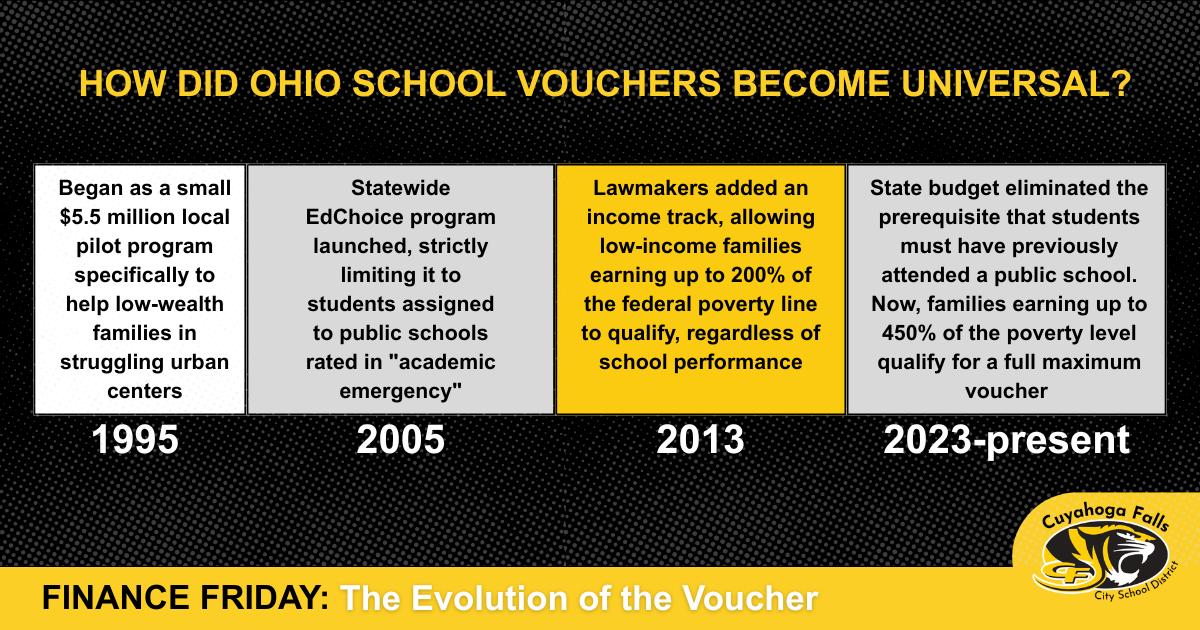
A chronological timeline that displays how vouchers went from a pilot program to a universal program.

Over the last decade, public education funding in Ohio has experienced a profound structural reorganization. While much public attention centers on local levy cycles, state-level allocations have increasingly pivoted toward the underwriting of non-public educational choices.

Chronology of an Incremental Expansion

Ohio's deployment of public revenues for private tuition accounts began as a heavily isolated local experiment. The progression from a targeted safety net to an open-ended entitlement program spans four distinct legislative milestones:

1995: The Cleveland Pilot Blueprint

The genesis of the voucher framework was established via the Cleveland Scholarship and Tutoring Program. Initiated as a $5.5 million state pilot, it was explicitly created to assist low-wealth families trapped in systemic municipal structural crises.


2005: Academic Performance Restrictions

The Ohio General Assembly formalized the Educational Choice (EdChoice) Scholarship Pilot Program, rolling it out statewide for the 2006-07 school year. This iteration was explicitly performance-based; a student could only access state voucher capital if their assigned home public school building was locked in a state-designated status of "academic emergency" or "academic watch."


2013: Income-Based Strategic Tracks

Lawmakers introduced the EdChoice Expansion track, introducing a secondary entry point detached from report card indicators. It permitted low-income families earning up to 200% of the federal poverty level to draw state funding for private tuition, introducing an income-based criterion into the broader framework.


2023: The Universal Policy Transition

The FY24-25 biennial state budget permanently transformed the operational philosophy of EdChoice. The legislature eliminated all historical requirements mandating that a student must have previously attended a public school district to achieve eligibility.

Under current rules, maximum scholarship allocations—worth up to $6,166 for K-8 and $8,408 for high school students—are universally accessible to families earning up to 450% of the federal poverty level ($135,000 for a family of four). For households scaling past that marker, partial state vouchers remain available on a sliding scale up to 785% of the poverty level (approximately $252,300 for a family of four).


Empirical Demographics: Retroactive Subsidies

The critical policy pivot of the 2023 universal expansion was the elimination of the public-to-private transition logic. Statistical tracking reveals that the resulting surge in voucher allocation does not reflect a mass relocation of public students into private environments. Instead, it functions as a retroactive state funding mechanism for families whose children were already privately enrolled.

Consider the direct evidence from recent state fiscal cycles:

The Enrollment Inversion: In fiscal year 2024, the state approved 67,991 new voucher students; 95.4% (64,831) of these recipients were already inside private classrooms. In fiscal year 2025, an additional 15,756 voucher students entered the program, with 81.8% representing existing private school cohorts.

The Private System Net Variance: Across the 2024-25 cycle, Ohio issued 69,000 new vouchers, yet total private school enrollment statewide expanded by fewer than 3,700 students. This empirical divergence proves that the vast majority of new vouchers simply replaced private tuition dollars with public tax allocations.

The Income Group Pivot: During the 2022-23 cycle, 67% of expansion voucher recipients originated from low-income households. Immediately following the universal lift, that low-income demographic cohort dropped to just 17%, confirming that the bulk of funding shifted into middle-to-upper-income brackets.

State Fiscal Ramifications

As a consequence of near-universal access, the state’s financial commitment toward private educational subsidies has experienced exponential growth. Annual voucher program expenditures have scaled aggressively:

FY2020: $394.2 Million 

FY2022: $554.5 Million 

FY2024: $970.7 Million (Universal eligibility launch)

FY2025: $1.095 Billion 

For the upcoming biennial budget cycle, state lawmakers have committed nearly $2.5 billion explicitly for private voucher funding.

This reallocation occurs as public school funding formulas face a statutory flat-freeze at fiscal year 2022 levels, culminating in a state-level formula shortfall to public districts estimated at $3.04 billion. Consequently, 595 out of 611 school districts across Ohio are now forced to project near-term operational deficits.

Public Schools vs. Private Voucher Schools: The Accountability Divide

Analyzing the Statutory Variance Between Public Systems and Private Voucher Schools


As the State of Ohio scales its financial commitment to private educational vouchers to an unprecedented $2.5 billion over the upcoming biennial budget cycle, a critical policy discussion has emerged around accountability. Public infrastructure is fundamentally bound to the principle that public expenditure requires public oversight. However, an examination of Ohio's revised code reveals a stark statutory variance in how public school districts and voucher-accepting private institutions are regulated.


The Regulatory Comparison Matrix

Public school districts function as transparent civic entities, answerable to voters, state regulators, and independent auditors. Non-public systems operating with public voucher capital retain private corporate status, leaving them exempt from the core accountability frameworks that govern public education.


SB 443: The Bipartisan Call for Fiscal Oversight

To resolve these structural imbalances, a bipartisan piece of legislation was introduced to the Ohio General Assembly known as SB 443 (titled the "Take the Dough, We Gotta Know Act"). Co-sponsored by Senators Kent Smith (D) and Bill Blessing (R), the bill operates on the premise that any institution accepting public education dollars must accept public transparency.

SB 443 proposes a uniform set of baseline transparency requirements for any private school accepting state voucher distributions:

  1. Fiscal Disclosure: Forcing voucher academies to submit to annual financial audits conducted directly by the Ohio State Auditor's office.

  2. Academic Standards: Mandating the publication of standardized academic report cards comparable to public K-12 systems.

  3. Safety and Oversight: Instituting mandatory criminal background checks for all newly hired educational personnel.

  4. Demographic Transparency: Requiring private institutions to report critical demographic indicators, including the specific enrollment metrics of students with Individualized Education Programs (IEPs), English language learners, and unhoused students.

The Public Implications

Without these legislative protections, public tax revenue effectively transitions into private spaces devoid of public record loops. While public districts face intensive scrutiny during localized tax levy campaigns to offset flat-funded state freezes, billions in state revenue scale upward to non-public settings without corresponding public audits or report cards.


Public Schools

Private Schools Accepting Voucher Funding

Annual state financial audits required by law

No annual state financial audits mandated

Standardized state report cards published annually

Exempt from state performance report cards

Governed by an elected, accountable Board of Education

Governed by private boards; no public elections

Bound by State Open Meetings and Sunshine laws

Private meetings; no public access requirements

Comprehensive public records access for community members

Exempt from state public records requests

All instructional staff must hold active state certifications

State teaching certifications are not uniformly mandated

Enrollment mandate: Must accept all residential students

Selective admissions; can reject based on profile/needs

Rigorous weekly student attendance tracking and reporting

No statutory weekly state attendance reporting rules

Mandatory criminal background checks for all employees

Background checks not universally required by voucher law

Transportation Mandated:

  1. All K-8 students living more than 2 miles from school
  2. Required to transport K-8 charter/private students who live up to 30 minutes away from their assigned school.  If busing is deemed "impractical," districts can declare the route an exception and must offer families a payment in lieu of transportation.
  3. Busing for students in grades 9-12 is optional for public schools; however, public schools are required to transport high school charter/private students if high school transportation is available for district students.

Exempt from transporting students

Special Education:
1. Mandated to follow Individualized Education Program (IEP) for students with diagnosed disability and provide services outlined in the IEP.
2. Mandated to provide service plans and services for students with disabilities attending private schools. (District is not reimbursed for providing services to students with disabilities at private schools)
Exempt from following and providing IEP accommodation and services for students with special needs

The Impact of Vouchers on CFCSD

Infographic with a chalkboard that states "it is $12,000 plus to educate a student," and bar graphs comparing the state funding given to our school district and voucher students.

Every financial decision made by the Ohio General Assembly has a direct ripple effect on municipal public school budgets. By examining the enrollment, funding allocations, and state mandates within the Cuyahoga Falls City School District (CFCSD), we can clearly see how the universal voucher system shapes our local tax environment.


The Per-Pupil Funding Inversion

The most direct operational friction caused by the universal voucher framework is the stark disparity in how public tax dollars are distributed per student.

By Fiscal Year 2028, CFCSD is projected to educate approximately 3,600 students. For these students, the state will provide the legal minimum of $822 per pupil.

In contrast, there are 609 students (according to 2024-25 data) residing within our district boundaries who utilize private state vouchers. Rather than receiving the public school base rate, these students receive a significantly larger allocation directly from the state's general education fund—up to $6,166 for K-8 students and $8,408 for 9-12 grade students. 


Local Demographics: Subsidizing the Existing Base

Proponents of universal vouchers often frame the policy as a vehicle to give choices to families who otherwise could not afford private education. However, localized analytical data reveals a different reality.


In Cuyahoga Falls, 81% of the families utilizing state private vouchers do not qualify as low-income under traditional financial support guidelines. Because the 2023 universal expansion removed the requirement that a voucher recipient must have previously attended a public school, the program now primarily acts as a retroactive tuition subsidy for middle-to-upper-income families whose children were already enrolled in private schools.


The Hidden, Unfunded Transportation and Special Education Mandates

One of the least understood aspects of the voucher system is that public school districts remain legally and financially responsible for specific operational costs of voucher students, even though those students do not attend the public school system.


By state law, public school districts are required to provide transportation for all K-8 students (public and private) who live more than two miles from their school, as well as charter and private students living up to 30 minutes away from their assigned school. If a public district provides busing for its own high school students, it must extend the same service to private high school students.


When constraints of time, bus availability, routing logistics, or financial resources make direct busing impossible, state law allows public schools to declare a route "impractical". However, the district cannot simply cancel the service; it is legally mandated to offer those families a "payment-in-lieu of transportation."


For the 2025-26 school year, CFCSD was required to issue a payment-in-lieu of transportation of $596 per student to the parents or guardians of approximately 164 K-8 private school students, creating an immediate, direct drain on local operational funds. 


The Reality of Levy Fatigue

When state funding formulas are flat-funded back to fiscal year 2022 levels and public tax dollars are increasingly redirected to private tuition accounts, a multi-billion dollar funding vacuum is created at the state level. Currently, 595 out of 611 school districts across Ohio are forecasting near-term operational deficits.


Ohio law provides public school districts with zero alternative state revenue streams when these deficits occur. To protect baseline classroom operations, standard utilities, and instructional staffing, public districts are left with only one legal option: looking directly to local voters for support through a property tax levy or a local school district income tax.

The Transportation Tipping Point

How Proposed State Policy Changes Threaten Public District Bus Routes

Over the course of our Finance Friday series, we have established how public tax dollars flow out of public systems via universal vouchers, analyzed the lack of state oversight on private school spending, and calculated the direct per-pupil funding gap in Cuyahoga Falls and Silver Lake.

To fully understand how state policy decisions manifest locally, we must look closely at our daily bus routes. Public districts do not just fund classroom instruction; under Ohio law, they serve as the default regional logistics system for both public and private systems. This week, we analyze the unfunded mandates of student transportation and a new state proposal that could eliminate our final financial guardrail.

The Origin of the Mandate: The 1965 "Fair Bus Bill"

To understand current challenges, it helps to look backward. In 1965, the Ohio General Assembly passed the "Fair Bus Bill," requiring public school districts to transport non-public and charter school students alongside public school students.

To prevent this bill from becoming a logistical and financial black hole for public systems, lawmakers instituted a critical guardrail: public school districts are not required to bus students to charter or private schools if the travel time exceeds 30 minutes from the public school of attendance.

Furthermore, if a district determines that a bus route is logistically unfeasible due to extreme distance, driver shortages, or low rider volume, the local Board of Education has the statutory authority to declare transportation for that student "impractical."

When an impracticality declaration is made, the district is legally mandated to provide financial compensation directly to the family, known as Payment in Lieu of Transportation (PILO). During the 2025-26 school year, Cuyahoga Falls City School District paid approximately $70,000 in PILO allocations to K-8 families whom we could not logistically or efficiently bus to private schools.

June 2026: The State Workgroup's Recommendations

In June 2026, the Ohio Pupil Transportation Workgroup, a committee composed of Ohio legislative officials and representatives from public, charter, and private schools, finalized a report aimed at addressing statewide student busing issues.

As reported by journalist Ella Diehl of the Columbus Dispatch, more than 22,000 students statewide were declared "impractical to transport" during the 2025-26 school year.

The Workgroup recommended several changes, most notably:

  1. Phasing out the Payment in Lieu of Transportation (PILO) option entirely, effectively forcing public districts to bus all eligible students regardless of logistical practicality.

  2. Developing a statewide transportation database and regionalizing bus routes.

  3. Increasing state funding allocations to follow individual students.

An infographic that compares current transportation policies and a proposal to change transportation policy.

The Local and Fiscal Threat

Managing these parallel transportation routes under current state funding formulas presents a structural challenge for public school districts. While school choice advocates see guaranteed access as a benefit, public school advocates view it as a potential unfunded mandate.

Without PILO, Cuyahoga Falls could be legally required to dedicate a multi-passenger school bus, fuel, and a driver, amid a chronic nationwide driver shortage, to transport just one or two private school students to a non-public school hours away.

Removing the impracticality tool without a fully funded, state-run parallel transportation framework shifts the physical and financial burden of private choice entirely onto the shoulders of public school districts and local property owners.

Traditional vs. Zero-Based Budgeting

Beyond Rollover Budgets: How Zero-Based Budgeting Drives Fiscal Accountability at CFCSD

To maintain public trust and practice sound fiscal management, a public school district must routinely evaluate how it allocates its resources. While state legislation, property reappraisals, and funding formulas set the parameters for revenue, internal budgeting practices dictate how efficiently those dollars are spent. This week, we examine Zero-Based Budgeting (ZBB)—the proactive framework Cuyahoga Falls City Schools uses to align every taxpayer dollar with student achievement.


Rollover Budgeting vs. Zero-Based Budgeting

Traditionally, school districts have relied on "rollover" or incremental budgeting. Under a rollover model, an administration takes the previous year’s budget as a baseline, adds an incremental percentage for inflation or wage adjustments, and carries over previous spending levels.

A chart that compares the traditional rollover budgeting versus zero-based budgeting.

The ZBB Process in Cuyahoga Falls

Implementing Zero-Based Budgeting requires significant time and administrative rigor, but it guarantees that every level of leadership remains actively involved in fiscal stewardship.


In CFCSD, administrators utilize cross-functional "decision units"—teams made up of grade-level representatives, subject-area teachers, and department supervisors—to build budget requests around two distinct categories:


  1. Needs: The essential, fundamental resources required to execute the written curriculum, support special education, ensure facility security, and operate buildings safely.

  2. Wants: Resources essential for providing specialized educational opportunities, expanding curriculum offerings, and sustaining overall district excellence.


During this review, administrators must ask rigorous operational questions:

  • Is this item necessary to execute the curriculum effectively?

  • How have supply needs changed over the past two years?

  • How does this expenditure directly support our strategic goals?

Tracking Every Account Dimension

Public school finance in Ohio relies on the Uniform School Accounting System (USAS), which categorizes expenditures across nine precise dimensions—including Fund, Function, Object, Operational Unit, and Job Assignment.


Through ZBB, our Treasurer's Office tracks thousands of specific budget accounts across elementary schools, middle and high school departments, operations, transportation, and special education. This detailed tracking prevents unnecessary rollover costs and eliminates end-of-year "spend-it-or-lose-it" mentalities.


Zero-Based Budgeting ensures that CFCSD operates with total financial transparency, operational discipline, and an uncompromised commitment to our community's students.

Understanding the Difference Between Public School Governance and Business Operations

Efficiency Matters, But the Public Mission is Different: Why Public Schools Are Not Private Enterprises

In discussions regarding government spending and local taxation, a frequently raised concept is that public school districts should be managed strictly "like a business." While applying principles of fiscal discipline, accountability, and strategic allocation is crucial for any public agency, equating a public school district to a private commercial business ignores the fundamental legal, structural, and moral realities of public education.


Public schools exist to fulfill a constitutional duty: delivering a free, appropriate public education to every child residing within district boundaries. Understanding the distinction between a commercial market model and a public service model clarifies how local tax dollars are deployed. 


Comparing Business Models to Public School Realities

Operational Dimension

Private Business Model


Ohio Public School Model (CFCSD)


Market / Audience

Selects target customers, products, and geographical service areas based on profitability.

Serves all entitled resident students under Ohio law, regardless of cost or degree of need.

Service Offerings

Discontinues products or services that do not align with profit margins or strategic targets.

Delivers legally mandated services (FAPE, IEP special education, specialized transportation, language support).

Revenue Generation

Raises prices, enters new consumer markets, or increases sales volume to generate income.

Operates within fixed public revenue set by state legislative formulas, tax laws, and voter levies.

Governance & Privacy

Executes strategic and financial decisions in private boardrooms away from public scrutiny.

Operates entirely in public view under Ohio open-meetings laws, public records compliance, and state audits.

Performance Metric

Financial return, net profit margins, market share, and revenue growth.

Public education outcomes: student achievement, literacy rates, graduation rates, and career readiness.


Statutory Mandates and Universal Service

A private enterprise maintains the legal authority to turn away customers if providing a service becomes financially unviable. Public school districts operate under federal and state statutory frameworks—including the Individuals with Disabilities Education Act (IDEA) and the Ohio Revised Code—that require districts to accommodate every resident child. Whether a student requires minimal classroom instruction or highly specialized, full-time nursing and behavioral support, the district’s legal duty remains absolute.


Fixed Revenue vs. Market Flexibility

When operational expenses rise for a commercial business due to inflation, the enterprise can adjust unit pricing or alter its supply chain instantly. Public school districts do not have market-pricing mechanisms. Revenues are bound by state funding formulas and local property tax constraints, such as House Bill 920, which cap voted revenue levels regardless of inflationary cost increases in fuel, utilities, or instructional supplies.


Sound Management Serves the Mission

Using modern fiscal tools like Zero-Based Budgeting ensures that Cuyahoga Falls City Schools operates with maximum efficiency. However, efficiency in public education serves a broader purpose than profit: it ensures that resources are stretched to fulfill our statutory duty to educate, support, and prepare every student in our community.

The Hidden “Time & Cost” of State Mandates

Over the last several years, public education in Ohio has undergone a quiet yet profound administrative transformation. While community conversations often focus on local facilities, academic performance, or general operating budgets, a growing portion of a public school district’s daily energy is dedicated to regulatory compliance.


According to the Buckeye Association of School Administrators, Ohio public schools have taken on close to 50 new or expanded state and federal mandates since January 2025. While many aim to address important issues, they frequently come without the state funding required to implement them.


While many of these policies address important societal goals, ranging from literacy interventions and student health to safety protocols, they often come with little to no state funding. Examining how these rules work in practice illustrates the day-to-day operational realities facing Cuyahoga Falls City School District.


Understanding the Implementation Gap

When a new law or agency rule is passed in Columbus, the work of making it operational falls directly on local school districts. Below is a snapshot of how compliance impacts district resources across multiple areas:


  • Uncompensated Financial Shifts: Sudden state rule changes can create significant local financial losses. Prior to the passage of House Bill 33 (Science of Reading), CFCSD invested approximately $1 million in a comprehensive literacy curriculum (Fountas & Pinnell). When HB 33 subsequently mandated that districts use materials strictly from a new state-approved vendor list, our recently purchased materials were disqualified. The district was unable to resell or recoup any of the $1 million investment, spent an additional $454,000 in local funds to buy an approved replacement, and had to completely repeat staff professional development.  The state provided only $185,801 to help CFCSD offset the cost of the new curriculum.


  • Administrative "Time Tax": Implementing new framework requirements—such as OTES 2.0 teacher evaluations, universal K–3 dyslexia screening, updated English Learner protocols, and SB 29 third-party data tracking—demands significant personnel hours. Time spent by principals, curriculum directors, and supervisors on compliance tracking and data entry is time redirected away from direct classroom coaching and student mentorship.


  • Mandated Operational Services: Requirements like expanded 4th and 5th-grade Reading Improvement and Monitoring Plans (RIMPs), specialized non-public transportation, and mandatory CPR/First Aid certifications for early childhood staff require dedicated staffing and scheduling adjustments regardless of district budget constraints. 


Our Commitment to Efficiency & Compliance

Cuyahoga Falls City School District takes pride in maintaining full compliance with all state safety, academic, and financial regulations. Every mandate is implemented with care to ensure our students receive a high-quality, safe, and supportive learning environment.


The Full Picture on Administrative Costs, Position Coding, and Fiscal Responsibility

Executive Summary

In public education, conversations regarding district finances often center on facilities, classroom instruction, and general operating funds. However, as state and federal compliance requirements expand, school districts must maintain appropriate administrative capacity to handle complex legal, safety, and operational mandates.

At Cuyahoga Falls City School District (CFCSD), we believe transparent stewardship requires helping our community understand how administrative roles are structured, how significant budget reductions have been executed, and why public salary databases often present an incomplete picture.

Proactive Fiscal Action: $6.73M in Reductions

Over the past two fiscal years, CFCSD has taken aggressive steps to align expenditures with revenue while protecting core instructional programs. Through strategic restructuring, CFCSD has reduced overall spending by approximately $6.73 million.

Demonstrating our commitment to a lean administrative structure, these spending cuts included the explicit elimination of 5 administrative roles:

  • 3 Building Administrators

  • 2 Central Office Directors

By absorbing these responsibilities across remaining staff, CFCSD has ensured that administrative overhead remains tightly controlled while protecting direct classroom support.

Understanding the Public Reporting Gap: Position Coding vs. Pay

Community members often utilize public search tools, third-party databases, or artificial intelligence engines to compare school district administrative overhead. While public data is an essential component of governmental transparency, raw online data without contextual understanding can create significant misconceptions.

How Position Coding Impacts Public Perception

  1. No Direct Link Between Coding and Compensation: Position codes reported to the State do not correlate to executive compensation or benefits. Many staff members categorized under "administrative" reporting lines do not receive executive-level pay or administrative benefit packages; they serve in operational support roles that are necessary for day-to-day regulatory compliance.

  2. Inconsistent Reporting Across Districts: Coding is not uniform across Ohio public schools. For instance, the exact same position—such as an Assistant Treasurer, coordinator, or specialist—may be coded as an administrative role in one district, but listed under a different classification in another district.

  3. Misleading Comparisons: Because districts structure their organizational charts differently, using raw online salary databases to compare "administrative spending" between districts creates an inaccurate comparison of completely different job functions and pay scales.

The Value of Leadership & Compliance Management

Administrative personnel in CFCSD ensure that the district satisfies approximately 50 new or expanded state and federal mandates enacted in recent years. Key operational areas managed by district leadership include:

  • State Academic & Literacy Mandates: Implementation of curriculum updates (such as HB 33 Science of Reading guidelines), staff training, and universal K–3 dyslexia screening tracking.

  • Data Privacy & Security: Managing third-party vendor compliance, student record safety, and software tracking required under Senate Bill 29.

  • Safety & Operations: Overseeing district safety protocols, mandatory staff certifications, non-public pupil transportation requirements, and special education legal compliance.

  • Evaluating every staff member in the district.

  • Discipline management

Without dedicated administrative staff to oversee these state-mandated operations, these burdens would fall directly onto teachers and classroom support staff, drawing their time away from instruction, lesson planning, and direct student mentorship.

© 2026. Cuyahoga Falls City School District. All Rights Reserved.